Softwashing explained: what it is and when to use it
Most people reach for a pressure washer without thinking. It’s sitting in the garage, it shifts grime fast, and it feels like the obvious move. That instinct, applied to the wrong surface, causes damage that costs significantly more to fix than whatever was growing on the roof or render in the first place. Stripped granules on clay tiles, fractured monocouche render, eroded mortar joints in period stonework: all of it is avoidable with the right method.
Softwashing explained simply: it’s the right method for a large category of exterior surfaces, doing the cleaning work with chemistry rather than force. At Alfresco Exterior Cleaning, we’ve been applying low-pressure chemical cleaning across Oxfordshire properties for decades, covering everything from modern silicone render to listed stone buildings. This guide covers how the process actually works, which surfaces need it, what the chemicals do, the safety and environmental picture, and the honest answer on whether DIY is worth attempting.
What softwashing is and how the process actually works
Softwashing is a low-pressure exterior cleaning method that uses chemical solutions to kill and remove biological growth rather than blasting it away with water force. The pressure in a softwash system typically runs under 200 PSI, often as low as 60 to 140 PSI for general house washes, and as low as 40 to 100 PSI for roof surfaces. For context, that’s comparable to a garden hose. The chemistry does the actual work, not the water.
The low-pressure delivery system
The Alfresco van-mounted softwash setup consists of a pump, a tank holding the prepared solution, and a low-pressure applicator that delivers the mix evenly across the surface. The applicator can reach significant spray heights, in many cases enough to treat roofs and upper-storey elevations without ladders. Using an application extension pole, even higher in Oxfordshire.Contrast that with a pressure washer, which generates force through restriction and is built to abrade. A softwash system is built to coat and treat. The surface gets cleaned without being ground down in the process.
What happens during dwell time
Once applied, the solution sits on the surface for a controlled dwell period. This is when the active chemicals penetrate and kill algae, mildew, lichen, moss, and bacteria at the root level. Rinsing too early cuts the process short and wastes the treatment. For surfaces like roofs, the solution is often left on entirely, continuing to work as weather rinses the dead growth away over the following weeks. For render and siding, a low-pressure rinse follows after dwell time is complete. The result is not just a clean surface but a treated one. This softwash treatment uses oxygen to help with the process.
Softwashing vs pressure washing: the honest comparison
Pressure washing is not wrong. It’s wrong for the wrong surfaces. Both methods belong in a professional’s toolkit, and the mistake isn’t using a pressure washer, it’s applying a 3,000 PSI machine to something that can’t handle it. For a local take on choosing the correct method for different exterior finishes, see our write-up on pressure washing vs DOFF exterior surfaces in Oxfordshire.
Where pressure washing genuinely belongs
Concrete driveways, block paving, brick walls, and hard stone patios are pressure washing territory. At 2,500 to 3,000 PSI, a pressure washer strips oil stains, compacted mud, and years of tyre marks efficiently from surfaces dense enough to take that force. There’s no need to softwash a concrete driveway when a pressure washer will do the job faster and more cheaply. For an accessible explanation of the difference between pressure washing and softwashing, see this industry overview: what’s the difference between pressure washing and soft-washing.
Why force alone doesn’t fix biological growth
Here’s the core limitation of pressure washing when used on organic growth: it strips what’s visible but leaves spores embedded in the surface. The algae or moss regrows, often faster than before, because the root structure was disturbed rather than killed. Softwashing kills at the root level, which is why results last significantly longer. On roofs in the UK climate, pressure washing results hold for less than a year in most cases. Softwashing on the same roof typically lasts three to five years, and on rendered walls you’re looking at one to three years, depending on shade exposure and local conditions. That lifespan difference is not marginal.
Softwashing explained: the surfaces that actually benefit
The practical test is straightforward: if the surface can be damaged by force, it needs a chemical approach. Across Oxfordshire, that covers a wide range of property types, from period farmhouses with lime render to modern homes with silicone cladding, to listed buildings where aggressive methods aren’t just inadvisable but potentially a compliance issue.
Roofs, render, and cladding
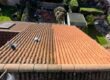
Roof tiles come first. High pressure on concrete or clay tiles strips protective granules, accelerates surface wear, and in many cases voids manufacturer warranties. UK tile manufacturers including Marley and Redland publish maintenance guidance recommending pressures no higher than 60 to 70 PSI for cleaning, firmly in softwash territory. Check their technical documentation directly for the most current guidance. For a focused practical guide on soft-washing roofs safely, see this complete guide to soft-washing roofs without damage.
Render tells the same story. Monocouche, pebbledash, and silicone render all carry real risk under high pressure: fractures, delamination, and water ingress behind the surface are common outcomes when the wrong method is used. Timber cladding, composite panels, and uPVC are equally unsuitable for high-pressure treatment. These delicate or porous surfaces are commonly best-served by softwashing, and biocide roof cleaning, in particular, is the standard professional approach for moss and lichen on tiles.
Older and period properties
Stone, lime render, and original brick pointing on heritage properties are particularly vulnerable. These materials are porous, often fragile, and have frequently been in place for a century or more. High pressure erodes mortar joints, lifts surface treatments, and can cause irreversible damage to finishes that can’t simply be replaced. Softwashing with appropriate chemical concentrations is the method used by specialists on listed buildings, and it’s what we use at Alfresco Exterior Cleaning when we work on Oxfordshire’s older stone properties. The approach is the same: let the chemistry do what force cannot safely achieve.
The chemicals used and what they actually do
Understanding the chemistry reduces most of the anxiety around softwashing. The compounds used are effective and manageable when applied correctly, and they’re not exotic. You’ll find the primary ingredient in household cleaning products.
Sodium hypochlorite and biocides
Sodium hypochlorite, essentially bleach, is the primary active agent in softwash solutions. Concentrations vary by surface and growth severity: around 0.5 to 2% for house washes and siding, rising to 4 to 6% for roofs with heavy moss or lichen. These dilutions are calculated from a stock solution typically running at 12 to 15%. Biocides, including algaecides and quaternary ammonium compounds, are added for more persistent biological growth. Their targets are algae, mould, lichen, mildew, and bacteria. The chemistry kills on contact and continues working during dwell time. Note that for sensitive renders such as monocouche, extra care is needed with concentration; always follow current industry guidance or consult a trained professional like Alfresco Exterior Cleaning with 30 years of knowledge in Oxfordshire.
Softwash detergents and why ratios matter
Softwash detergents, surfactants, are added to help the solution cling to vertical surfaces, slow evaporation, and improve penetration into the substrate. They’re the reason a softwash mix works on render rather than simply running off before dwell time completes. Mixing ratios matter significantly: a solution that’s too weak won’t kill growth effectively, and the job fails. Too strong, and you risk damaging surface finishes or harming nearby plants. Getting this right is precisely where DIY application goes wrong most often, and where professional calibration delivers a meaningfully different result. Don’t be a closet chemist and just mix a few bits together; it could be fatal.
Safety and environmental considerations
Softwash chemicals are effective because they’re active compounds. That effectiveness comes with responsibility during application. The risks are manageable with the right preparation, and understanding them helps you assess whether a contractor is operating responsibly. The team at Alfresco understand the three D’s in soft washing: Dilute, Divert and Decontaminate.
Protecting plants, drainage, and surrounding areas
Sodium hypochlorite can harm plants, aquatic life, and soil microbes if runoff isn’t managed. Pre-application steps matter: sheeting off borders and flower beds, pre-wetting soil and grass to dilute any contact, and using conditioner rinses or neutralisers after application. Under the Water Resources Act 1991 (Section 85), chemical runoff entering watercourses or storm drains is a legal issue, not just an environmental courtesy, the Environment Agency sets out clear obligations for anyone discharging to controlled waters. Careful application at appropriate dilutions near sensitive areas reduces risk significantly, but it requires attention and planning before the first drop of solution goes down. This is why Alfresco use – Plant wash to neutralise any harmful chemicals.
What professional-grade handling looks like
At higher chemical concentrations for biocides, PPE requirements include gloves, eye protection, and in closed areas, respiratory protection. Professionals assess drainage routes, prevailing wind direction, and nearby vegetation before any application begins. Responsible contractors follow Environment Agency guidance on hazardous substance handling, use biodegradable surfactants where possible, and maintain COSHH risk assessments, as required under the Control of Substances Hazardous to Health Regulations 2002, for the chemicals they use on site. When you’re talking to a potential contractor, these aren’t unreasonable things to ask about. A competent operator will have straightforward answers.
DIY or hire a professional: the honest answer
DIY softwashing is possible. Agricultural sprayers are available, sodium hypochlorite is accessible, and the basic process isn’t complicated in principle. But the gap between a competent professional application and an inexperienced first attempt is wider than most people expect. This isn’t gatekeeping, it’s a realistic assessment of where mistakes happen and what they cost to fix.
Where DIY softwashing typically falls short
Four failure points come up repeatedly in DIY attempts:
- Incorrect solution concentration. Too weak and the growth survives; too strong and you risk damaging render or harming surrounding planting.
- Inadequate dwell time management. Rinsing too early wastes the treatment entirely.
- Poor rinsing technique. Chemical residue and uneven coverage are common outcomes with improvised equipment.
- Working at height with corrosive chemicals. This is a real safety risk that improvised setups routinely underestimate.
The cost of a failed DIY attempt on a rendered wall or a tiled roof can far exceed the cost of hiring someone who knows what they’re doing.
What to look for when hiring a softwashing contractor
A competent contractor brings trained application technique, correct chemical knowledge, adequate insurance, and a body of verifiable local work. Certifications from industry bodies like SoftWash Systems indicate formal training in chemical safety, dilution ratios, and environmental compliance, check their websites directly for what each programme covers. Beyond paper qualifications, look for a track record with property types similar to yours. A contractor who has spent years working on a varied mix of period stone, modern render, and clay tile roofs brings practical context that no manual can fully replicate. Check out Google Reviews.
That’s what Alfresco Exterior Cleaning offers: decades of family-run exterior cleaning work across residential and commercial properties throughout Oxfordshire. No overpromising, no shortcuts on chemistry or process, just grounded local expertise applied to surfaces that need it done right. If you want results that last rather than a surface that looks clean for a few months before the growth returns, that distinction is worth taking seriously. Learn more about our approach on our Alfresco Softwash page.